

Summary
The page below provides a detailed table analyzing marketing campaigns: campaign types, channels used, and performance metrics.
Let’s see what crypto marketing winners can teach us:
- The analyzed campaigns show us that a systematic campaign is more important than just some marketing tricks.
- A good marketing campaign is always prepared with various aspects in mind. The audience, specific performance metrics, preparation plan, and compliance with legal are all taken into account.
- Storytelling still important: Coinbase's economic satire film and OKX's Tribeca-backed "Mild Mild West" got big earned attention.
- Brand partnerships are also particularly effective in large-scale promotional advertising, rather than one-off projects.
- Using different media strategies, rather than sticking to one, is also important for success.
- Community matter: Kraken's F1 memecoin showdown prize, Gate.io's full season collectible drops with Red Bull Racing.
- All examples are related to long-term projects and businesses. While short-term projects most often cause a stir by accident - we are not talking about organizing an advertising campaign here.
- Reliability pays off: Gemini's multi-year Bitcoin football club deal, Tether's Juventus ownership path.
- You need to take into account possible mistakes: Determine the adaptability of your budget for the campaign. Take into account local geo nuances and advertising requirements in the field in which you work. Have a plan for at least two weeks before starting work.
When plan your next campaign, ask: what's the one clear thing we want people to do, how do we make sure they stick around after? The article says where the wins are hiding.
The landscape for crypto marketing campaigns 2026 was harsher than ever compared to previous years. There was more regulation, more restrictions on paid ads, and much higher user skepticism across almost all markets. Attention was more fragmented than ever, which created a tougher environment for crypto campaigns than in any previous cycle. The period when a project could get by with a few influencer tweets or a flashy airdrop was clearly over.
However, even amongst all of this noise were some impressive growth-driving marketing efforts for some crypto projects. These minor success stories drove signups, on-chain activity, Total Value Locked (TVL), volume, and allowed for long-term brand positioning. These marketing efforts were acquired with systems versus just relying on luck, hype cycles, etc.
These campaigns combined carefully crafted narratives distributed through optimal channels with incentive schemes tailored to user psychology. Each initiative was measured against well-defined Key Performance Indicators (KPIs). In this article, we examine eight crypto marketing campaigns from 2026 to provide actionable examples for anyone in the field.
How to Analyze a Crypto Marketing Campaign in 2026
If you want to “reverse-engineer” a campaign, don’t start from the creative. Start from the system behind it. In 2026, the best campaigns were designed like funnels — even when they looked like art, sport, or culture.
Here’s the simple frame we use when we audit campaigns:
- Narrative: What story are they telling, and what are they reacting to? (fear, frustration, identity, status, rebellion, safety, belonging).
- Audience + stage: Retail or pro? Pre-launch, launch, growth, retention?
- Channel mix: Where does attention come from (PR, creators, paid, community, partnerships, IRL), and where does it convert?
- Incentives: What makes people act now (rewards, access, status, quests, referrals)?
- Measurement: What counts as “moved the needle” (signups, first deposit, staking volume, trading volume, on-chain activity, retention)?
When you put those five layers on paper, you’ll see why some “viral” ideas are dead on arrival: the narrative doesn’t fit the market moment, or the incentive attracts farmers, or the conversion path is fuzzy.
Quick campaign checklist
- Do you know who the specific audience segment will be and have you identified that?
- Do you understand the one KPI that matters above all others and what the 2-3 supporting metrics will be?
- Is the channel mix realistic to what your team can handle (content, community management, customer support, etc.)?
- Does the offering provide quality users rather than merely "hunters" (anti-Sybil/anti-farming considerations)?
- Can someone go through the entire experience of your campaign in one sitting without needing to wait for further information?
- Do you have plans following week 2 and 4 of launching (for subsequent notifications to previous participants) to help with retention/re-engagement?
- Have you met the geo-specific laws and rules of your industry and have you complied with disclosure and representations?
Keep this checklist handy — we’ll reference it again at the end.
8 Crypto Marketing Campaigns of 2026 That Actually Worked
Before we get into the detailed analysis, here’s a quick overview. The purpose of the table isn’t to judge who’s the best. It’s to help you quickly see patterns: what type of campaign, which channels delivered the reach, and which KPI was likely the real target. And one more thing, we think it’s best to see the comparison in table form, so we’ll be happy if that’s the case.
Top Crypto Marketing Campaigns of 2026
Now let’s break them down properly.
Campaign #1 – Coinbase: “Everything Is Fine” (UK)
Context & goal. When Coinbase started their efforts within the UK, there was a lot of economic pressure from rising costs and general dissatisfaction with existing systems; therefore, Coinbase decided to take an alternative approach. Rather than using traditional advertising methods within the crypto space (i.e., generative art, technical complexity, etc.), they used art that expressed an absurdity regarding the 'glamorous' aspects of cryptos and the world we live in today.
What they actually did (channels and creative). The centerpiece of the project was a short, two-minute film that is stylized as a musical but has darkly humorous undertones in regards to how we function within society today. The creative work's strength was due to how remarkably "real" it seemed, thus provoking the audience to take notice, with distribution enabled through traditional PR and conversation.
FINPR POV. We would have paired the creative with a clearer next step offer, such as a demo or a reward for being on a waitlist, which would not attract attention from farmers. An educational mini-challenge can also be paired with the advertisement to create a much stronger tie between the advertisement and product use by providing a way to action the product upon successful completion of the educational mini-challenge.
Takeaways (actionable).
- If your message can’t be repeated by a normal person, it’s not a campaign.
- In 2026, tone is a targeting tool — satire can filter in the right audience.
- If you go culture-first, make sure step two is crystal clear.
Campaign #2 – OKX x Tribeca: “Mild Mild West”
Context & goal. For many years, Crypto has been labelled the Wild West. This perception has put Crypto in a difficult situation with the discussion and regulation of the different accepted forms of currency and the adoption of the coins into mainstream society. To combat these difficulties, OKX launched a short film titled Mild Mild West, which was a collaborative effort with Tribeca's film festival, and cleverly challenged the perception that Crypto is the "Wild West."
What they actually did. A film asset was developed and a credibility layer (Tribeca) used to promote the film in conjunction with an event press release. The premiere coincided with the announcement of OKX Pay on the same day, demonstrating how to combine Culture + Distribution + Product through proper campaign design.
FINPR POV. This is a great example of “earned media engineering.” The trick is to ensure the product offer is not an afterthought. If we’re adapting this for a DeFi or infra project, we’d build a narrative that simplifies the benefit (speed, safety, cost) and make the launch moment feel like news, not marketing.
Takeaways (actionable).
- Borrow trust from a world that isn’t crypto.
- Pair brand storytelling with a real product milestone.
- Reframing an old meme can be more powerful than inventing a new one.
Campaign #3 – Binance Wallet: Stake TON to share $300,000 in rewards
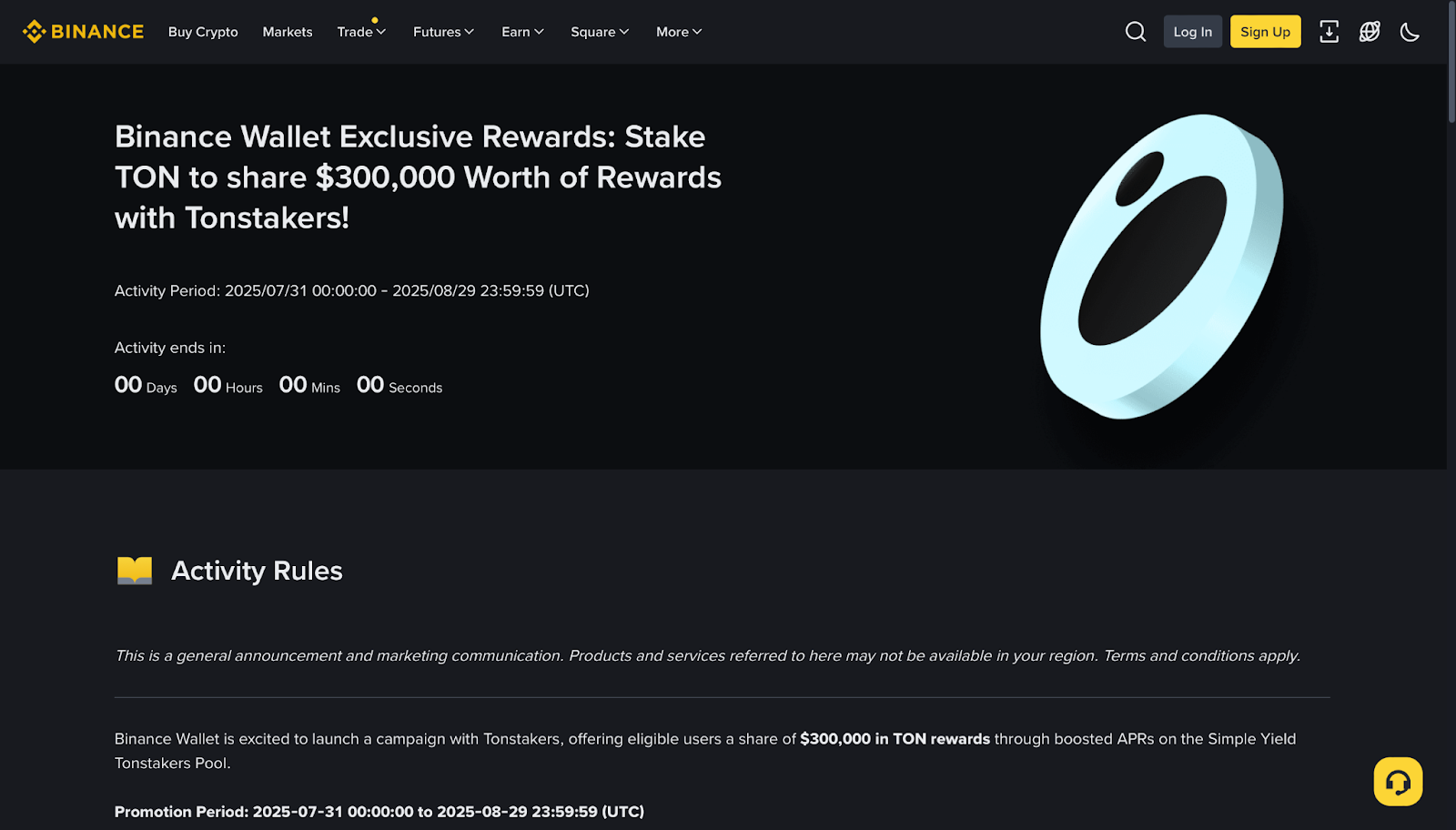
Context & goal. In the year 2026, shipping improved in-game rails enabled many wallets to grow: earn, stake and a straightforward yield. A simple promotion from Binance Wallet and Tonstakers... stake TON, and receive a portion of the $300,000 rewards pool - including a clear campaign timeframe (2026-07-31 to 2026-08-29 Universal Coordinated Time)
What they actually did. This was not just a publicity stunt; it was performance marketing for the product itself. It was executed at the location where the greatest success would occur, a consumer's wallet when they are within reach of purchasing. There were two main instruments utilized to accomplish this goal, enhanced interest via added opportunity, and a singular clear promise: do one thing (i.e., staking) to gain access to the full reward.
FINPR POV. Using incentives instead of narrative is a frequent oversight. The narrative may be nonexistent or minimal at times during wallet/product campaigns, but a well-defined narrative is still essential so that the results of the experiment can be compared and evaluated to other experiments. If we're running this for a small product, we determine success as "activated stakers who remain active after 30 days", instead of simply looking at TVL spikes.
Takeaways.
- Put the campaign where conversion already happens: in-product.
- One action, one promise, one timeline beats “quests soup”.
- Reward designs should favor retention, not just signups.
Campaign #4 – Kraken x Williams Racing: Rear Wing Takeover (Memecoin Showdown)
Context & goal. Memecoins attract people's attention, but gathering that attention is chaotic. To format this chaotic market into an organized competition, Kraken monitored memecoin trading activity in the Kraken App, from July 8 - August 8, 2026. The winning memecoin was placed on the rear wing of the Williams Racing F1 team car. The placement was announced at the moment of the Singapore GP.
What they did. It created a trading competition around which communities could come together, with the winning community being recognised, thus giving communities a reason to work together to promote and share the initiative themselves, ultimately leading to free distribution of the campaign.
FINPR POV. These campaigns can create a dramatic increase in volume within a short period of time, then fall off dramatically. To mitigate this, you must create "guardrails" around these types of contests and campaigns. For example, if you were to run a "community showdown", you would pair that event with an activation path following it to facilitate referrals to use the product, retain users through quests, and give winners access to gated rewards that allow them to continue to feel engaged after the contest has ended.
Takeaways.
- Status prizes can outperform cash prizes for community-driven growth.
- Let communities do the marketing, but design the rails and rules tightly.
- Always plan the post-campaign retention phase.
Campaign #5 – Gate.io x Oracle Red Bull Racing: “IN THE MOMENT” digital collectibles
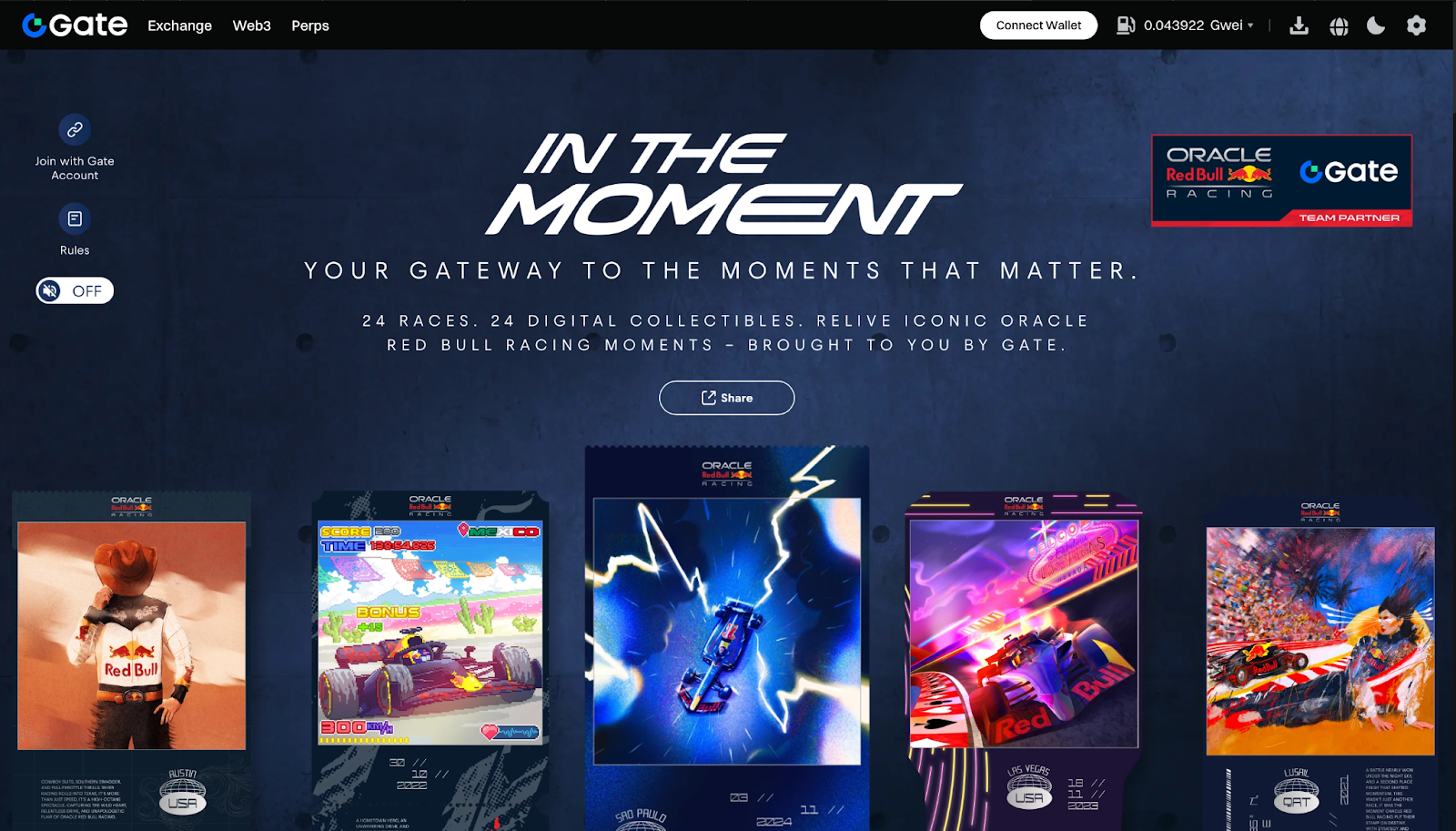
Context & goal. Sports partnerships are expensive, and in crypto marketing campaigns they often fail because they stop at logos. Gate.io pushed beyond logo placement with an ongoing collectible series tied to the 2026 F1 season: 24 races, 24 digital collectibles, framed as "In the Moment".
What they did. To begin with, they partnered with Oracle Red Bull Racing, a well-known and highly regarded partner in the industry. The partnership provided a way for them to reach consumers. As a next step, they introduced a series of engagement strategies throughout the entire season, including a series of recurrent drops that tell a story over time, and a reason to return. The structure is very important; instead of just one drop of NFT's over time, they have established a pattern that corresponds to the sports calendar.
FINPR POV. For partnerships to be successful, they need to be tied to a product or action. If we were to apply this approach to a smaller Web3 product, there will be a clear expectation of measurable behaviours that will accompany each drop: connection to a wallet, making a first transaction, staking, referring someone else or adopting a new feature. Further, we would keep the experiences very straightforward so that typical fans do not leave the partnership experience early.
Takeaways.
- Turn sponsorships into systems, not logos.
- Cadence creates retention.
- Completion mechanics are underrated in web3 marketing campaign ideas.
Campaign #6 – Crypto.com: TON App Campaign (Net-Buy Challenge)

Context & goal. Some marketing efforts can really benefit by being labelled as "number campaigns". There is nothing wrong with creating an authentic marketing campaign that is a "Numbers Campaign". A recent example of this is the Crypto.com TON App Campaign. This was an opportunity for those who purchased or deposited Ton coins to qualify to enter a contest based on their "net buys" amount. The Contest mechanics were clearly stated publicly; The first 3000 of the qualifying entries with the greatest (net buys of Ton coins) amounts would receive $10 in Bitcoin each; The contest had a time window (April 3, 2026 - April 17, 2026 UTC).
What they did. They created a package of simple conversion actions (buy/deposit) based on a leaderboard concept, and paired it to a stable reward (BTC). This is important because, when you pay in BTC, the experience is less “promotional token” based and more “real prize”.
FINPR POV. Promotion campaigns that provide prizes only to the best performers tend to be demotivating for those performers who are in between top and bottom performance levels. When developing performance-based promotions, we generally like to use a hybrid design — a two-tiered baseline reward + an incentive based on a small leaderboard for hype.
Takeaways.
- App-native promos are the most controllable growth lever in 2026.
- Reward design shapes who shows up (whales vs real users).
- Tiering often beats pure leaderboards for long-term goodwill.
Campaign #7 – Gemini x Real Bedford: the “Bitcoin-backed club” story
Context & goal. Not all campaigns involve paid media. There are some that are based on developing credibility and building that credibility over time. An example is Gemini Real Bedford story; it is a great example of how to create a story around community and commitment. With the announcement of their 5-year sponsorship of Real Bedford FC, Gemini made this announcement and signed the contract upfront with payment made using bitcoin. The additional aspect of the story was that the Winklevoss brothers had previously made significant investments into the club, and local coverage later confirmed their investments of $4.5 million and control of 45% of the club's ownership.
What they did. They linked their brand to a real project, the story of which is focused on people: a small football club striving for big goals, supported by cryptocurrencies, investing real BTC in it. The PR approach is easy to understand even for a non-crypto audience: payment in Bitcoin, multi-year agreement, community support.
FINPR POV. Although the stories themselves contain the foundation for conducting a successful campaign while giving you something to put in your quarterly updates, they will not carry any weight without continuous updates about them through the media such as "behind the scenes - outcomes - measured impact". If we do not manage our campaigns in this way, then we lose momentum, just like a press release will eventually do over time.
Takeaways.
- Credibility campaigns can outperform ads when trust is the bottleneck.
- Long-term commitments read as real; one-offs read as PR.
- Make impact trackable, or the story dies after the headline.
Campaign #8 – Tether x Juventus: strategic stake-building as marketing
Context & goal. Juventus Tether does not rely on an exchange or app installer to acquire new users. Instead, Tether has established itself as a network infrastructure provider with multiple opportunities to build a positive reputation. One of Tether's most high-profile reputation-building activities took place in 2026. It was reported that Tether had established itself as a minority owner of Juventus FC. In February 2026, it was confirmed by Reuters that Tether owned a small percentage of Juventus shares and that Juventus shares had jumped following Tether's acquisition of the minority stake.
What they did. This is a corporate strategy to promote itself using the news cycle. Mainstream Business News, Sports Business News, and the endless commentary are a way to keep the Company in the conversation, in a much more serious sense than normal advertising within the Crypto world.
FINPR POV. A company being publicly visible does not guarantee that customers trust that company. For example, if a small project utilizes the concept of "institutional association" to capitalize on that company's corporate visibility while lacking the necessary product integrity, this will harm rather than help the project. Instead, we would use this approach only when an organization has a very solid base for their organization and has excellent communication and supporting materials.
Takeaways.
- In 2026, legitimacy is a distribution channel.
- “Stake” stories travel further than “banner ad” stories.
- Don’t chase credibility if your product can’t survive scrutiny.
What These Campaigns Tell Us About Crypto Marketing in 2026
Once you eliminate logos and title bars, you can see that all viral crypto marketing campaigns initiatives of 2026 were based on systems rather than marketing tricks. Even though some methods of winning were very elaborate, they still used repeatable methods, had real distribution and could be measured in some form.
A second pattern consisted of using storytelling to promote off-chain activity but having the on-chain promotion and/or in-app action to capture that storytelling. If an initiative only did storytelling, it got recognition from others but not market share. If they only did incentive products, they ended up with just farmers and unsustainable churn. Successful companies used a blend of the two patterns to create their strategies.
The third pattern involved companies leveraging partnerships by building structures around the “why now” and timing of each campaign. For example, Gate.io didn’t just put its logo on a vehicle, it developed a season-long mechanic to leverage that partnership through the mechanics of a season; while Kraken created a community competition around F1 and had a start/stop date attached to it. By leveraging the timing of that partnership, Gate.io and Kraken turned partnerships into more than just expensive posters.
A Simple Campaign Blueprint for Web3 Teams
The first step is to determine the narrative for the villain. Using plain English, state what problem your organisation is fighting against (e.g. poor user experience, excessive charges, slow payoff, limited availability, ineffective incentives).
Step Two: Determine your campaign's key performance indicators (KPI) and stage of development. Is your campaign launching (wait list to activation), growing (deposit to 1st transaction), retaining (repeat customers) or expanding (new geographic locations/target markets)? Identify the single KPI that is most significant.
Step Three: Build an appropriate media strategy based on your resources. If you do not have the time or ability to produce new content every day and/or administer your community, don't create a campaign that requires these actions.
Step Four: Create incentives tailored to your user quality goals. If you are looking for long-term users, create incentives that encourage long-term behaviour. If you are looking for high volumes of users, understand that you are "buying" users by offering volume-based incentives; however, also plan for the retention follow-up.
Reliable measurement of on- and off-chain actions is essential to evaluating success. Measure both what happens to your platform as well as what happens to users' attention (i.e., press coverage, influencer posts, and search increases). If you can't measure it, you won't be able to enhance it.
Common Mistakes When Copying “Famous” Crypto Campaigns
Utilizing the surface layer of a high-visibility campaign without understanding the underlying mechanics is one of the most common mistakes when developing a budget.
- Using an established budget but recreating it instead of building your own.
- Implementing large bonuses without a solid anti-farming campaign design.
- Failing to be compliant with state and local laws, geographical locations, and advertising platform regulations.
- Focusing on optimizing non-purchase related metrics.
- Not having a week 2 follow-up plan.
When to Call an Agency (and What FINPR Actually Does Here)
If your team is trying to run a multi-channel launch — PR, creators, paid, community, partnerships — you’ll quickly discover the real bottleneck is not ideas. It’s orchestration and measurement. The moment you need creative, media mix planning, execution, and reporting to work together, an agency becomes a force multiplier.
From the agency side, this is what the work usually looks like in reality: discovery (product + audience truth) → strategy (narrative + KPI + funnel) → creative concept (assets that match channels) → media mix (earned + paid + creators + community) → execution → reporting and iteration. And yes, the boring part matters: weekly dashboards, cohort thinking, and “what did we learn” loops.
Conclusion
The best crypto marketing campaigns 2026 weren’t magic. They were designed like products: one promise, one primary KPI, and a channel system that made the action easy. Some used culture, some used sports, some used pure app mechanics — but none of them relied on random shilling.
If you’re building a Web3 project, don’t try to copy everything in one go. Pick one mechanism from these cases, run a smaller experiment, and measure it properly. If you want help turning a good idea into a real, trackable campaign system — not just a loud launch week — that’s exactly where FINPR typically plugs in.

